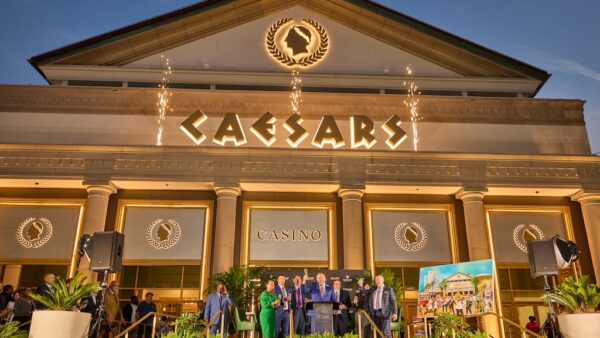
Three weeks of revenue data from the New York State Gaming Commission have reframed the conversation around the downstate casino market — and around MGM Resorts’ decision to walk away from it. Since Resorts World New York City converted from a slots-only racino into a full commercial casino on April 28, the numbers have been striking.
Statewide commercial casino gross gaming revenue for the week ending May 3 was $41.3 million. The following week, $40.1 million. For the week ending May 17, $41.8 million. The week before the conversion, the four upstate commercial casinos combined for $13.4 million. Resorts World alone is now generating roughly $27 to $28 million per week — more than twice the combined revenue of every other commercial casino in New York State.
A weekly run rate of $28 million projects to approximately $1.45 billion annually. As a racino, Resorts World generated $692 million in net win for fiscal year 2024-25. The conversion has, on very early evidence, roughly doubled the property’s revenue.
Table of Contents
What the numbers mean for MGM
In October 2025, MGM Resorts withdrew its $2.3 billion bid for a Yonkers casino licence, citing two primary concerns: the competitive landscape had become too crowded, with four proposals clustered in a small geographic area, and the state had revised the licence term from 30 years to 15. Together, MGM argued, those changes made the investment no longer justifiable.
Three weeks of Resorts World data suggest those concerns may have been significantly overstated — or that MGM simply misread the timing.
Table revenue is below expectations — but it hasn’t mattered
Not everything about Resorts World’s early performance has been on target. Table revenue has come in below internal projections. Maybank analyst Samuel Yin Shao Yang noted that tables produced approximately $4.9 million in the first six days — equivalent to around $3,400 per table per day — against an internal benchmark of $5,400. The shortfall has been described as underwhelming relative to Macau-style expectations.
But the underperformance on tables has not prevented Resorts World from dominating the state. Slot revenue has been strong, and the property is generating more revenue as a soft-opened casino with an incomplete table mix than the entire upstate market combined. The early data is tracking close to the $1.56 billion net win projected in Resorts World’s application to the Gaming Facility Location Board.
The fiscal picture
The numbers also look compelling from a public finance perspective. Resorts World paid a $600 million licence fee. At a blended tax rate of roughly 50% on slots and 30% on tables, the property is sending the state approximately $13 to $14 million per week in gaming taxes. At that rate, the licence fee is recovered in less than a year of incremental tax payments above what the racino was already generating.
For the Metropolitan Transportation Authority, the picture is equally encouraging. The MTA had budgeted $1.8 billion in casino-related revenue across all three downstate licences between 2026 and 2029. Resorts World alone is projecting $2.5 billion to the MTA over the same period — suggesting the entire downstate programme may significantly outperform its own budgeted economic impact, primarily on the strength of the one property that opened first and faces no meaningful competition.
The monopoly window MGM underestimated
The element of MGM’s reasoning that holds up least well under scrutiny is its competitive timing assumption. MGM’s analysis appears to have assumed that Empire City would convert to a full casino around the same time as the two greenfield projects — Bally’s Bronx and Hard Rock Metropolitan Park — meaning it would face direct competition almost from the start.
That assumption looks significantly weaker now. Bally’s is targeting 2030. Hard Rock Metropolitan Park’s construction has already fallen more than five months behind schedule, with a key parking structure missing its January 2026 start date. Resorts World will almost certainly have three to four years of monopoly downstate operation before meaningful competition arrives.
Over a four-year monopoly window, the property is on track to capture roughly $2.8 billion in incremental revenue above what the racino was producing — before competitive pressure arrives at all. Empire City, which has generated approximately $5 billion in lifetime state taxes since 2006 and had a substantial existing customer base under MGM ownership, could have run the same playbook. The fact that MGM did not raises a genuine question about whether the company misread its own competitive position.
The honest verdict
MGM’s October decision looks worse with every weekly revenue report that comes out of Queens. The competitive cannibalization it cited will eventually arrive — but later than the company assumed, and with a monopoly window large enough to make the economics work very differently. The 15-year licence term is a real constraint, but Resorts World is on pace to recover its licence fee in roughly one year of incremental tax payments, which suggests the term horizon was considerably less of a deal-breaker than MGM made it out to be.
MGM said the economics didn’t work. Three weeks of data from the property that stayed say they really should have.