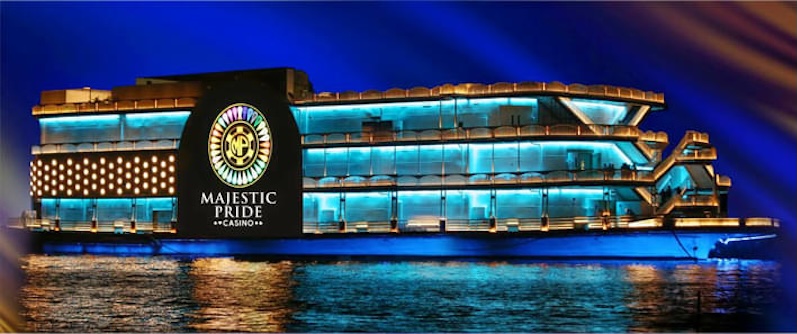
The Bombay High Court in Goa has barred the MV Deltin Royale — a 112-metre, seven-storey vessel with a capacity of 2,000 guests — from joining the cluster of floating casinos on the Mandovi River. The ruling, handed down on May 6 by Justices Valmiki Menezes and Amit Jamsandekar, states that the vessel may not sail into Panjim Port without a certificate of survey confirming its seaworthiness, and that even if such certification is obtained, it cannot enter the port without prior court approval.
The decision effectively blocks the Deltin Royale from replacing a smaller 70-guest casino boat currently operating on the river — a replacement that would have dramatically increased the floating casino’s footprint on the Mandovi.
Table of Contents
Environmentalists win this round
Opposition to casino boats on the Mandovi has deep roots in Goa. Environmentalists and local communities have long argued that the vessels pollute the estuary and damage local fisheries — and in the case of the Deltin Royale, the concerns were amplified by the sheer scale of the proposed addition. The ship’s guest capacity exceeds that of all six existing riverboats combined, and even port officials had warned it could create navigational hazards and bottlenecks at mooring positions.
Father Bolmax Pereira of the Archdiocese of Goa and Daman’s Commission for Ecology welcomed the ruling, describing it as “symbolic of a larger pattern of unsustainable development in ecologically fragile zones.” For Goa’s environmental advocates, the court order represents a meaningful, if temporary, victory in a long-running battle over the river’s future.
Gambling’s role in Goa’s economy
The stakes of this dispute extend well beyond environmental policy. Gambling is legal in only three of India’s 36 states and union territories — Goa, Sikkim, and Daman and Diu — making Goa’s casino industry a genuinely rare asset in the Indian context. The state, sometimes described as the Las Vegas of India, currently hosts 13 casinos: seven onshore and six offshore.
The financial contribution is substantial. Local government casino revenue peaked at ₹603.76 crore in 2023-24, with ₹461.71 crore collected in 2024-25. That income funds public services and infrastructure across the state — giving the industry a strong economic case even as it faces persistent regulatory and environmental scrutiny.
What comes next
The district bench has scheduled a follow-up hearing for July 6, where it will continue to hear arguments from local opponents and Delta Pleasure Cruise Company Ltd, the Deltin Royale’s operator. The court has also ordered officials to investigate a mass fish die-off in Panaji in April — an incident that has further heightened environmental concerns surrounding the river.
Chief Minister Pramod Sawant stated in March that the state has no plans to license new offshore casinos, suggesting that even if the Deltin Royale eventually clears its legal hurdles, the broader expansion of Goa’s floating casino industry is unlikely to accelerate in the near term.
A broader reflection on regulated gambling
Goa’s casino boat controversy is a reminder that the debate around gambling regulation is rarely straightforward — balancing economic contribution against environmental impact, community sentiment and navigational safety. It also underlines why the shift toward safe online casinos has gained momentum in markets where physical gambling infrastructure faces such complex pressures. Safe online casinos operate without the environmental footprint, navigational risks or community disruption associated with large physical venues — offering players a regulated, accessible alternative that delivers the same entertainment value without the broader social trade-offs that cases like Goa’s Mandovi River dispute so vividly illustrate.